
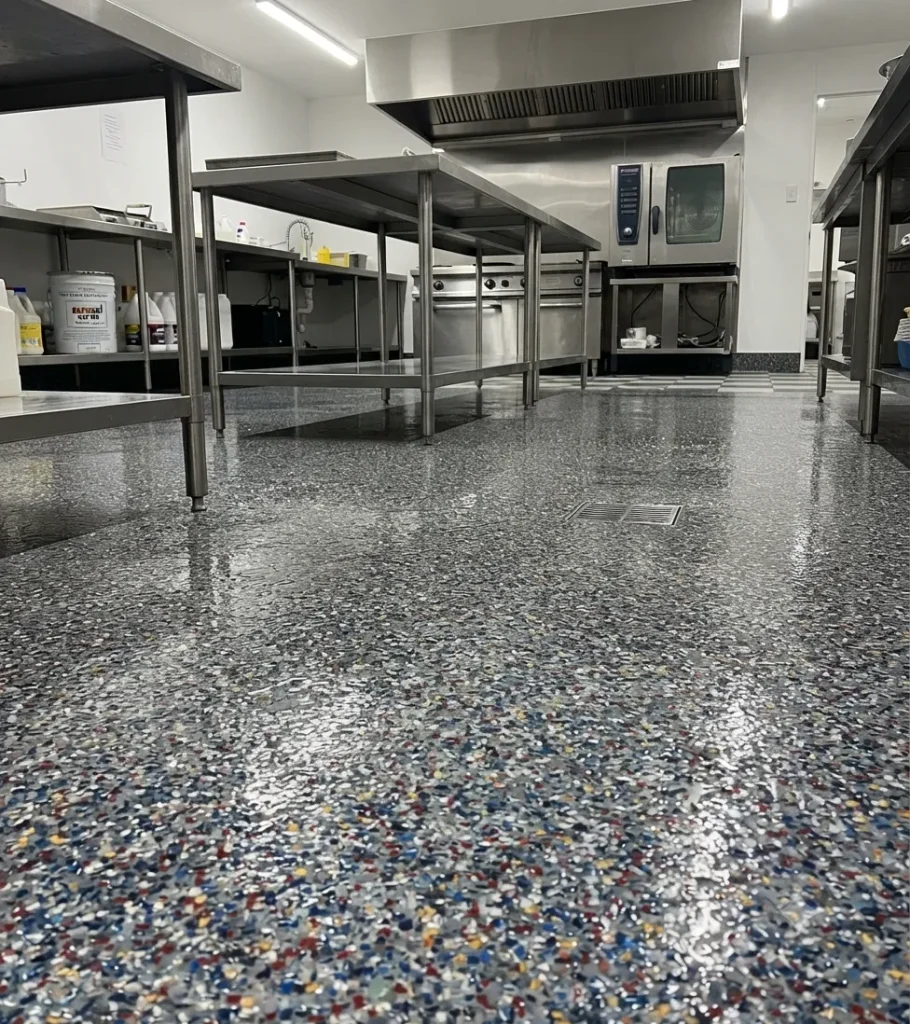
Compare commercial kitchen concrete floor coatings for cleanability, chemicals and slip resistance. Explore Australian-made options from Auseal.
Commercial kitchens expose concrete floors to grease, water, cleaning chemicals and constant foot traffic. Contractors therefore need to assess more than colour or gloss when selecting a coating. The substrate, operating conditions, cleaning program and required slip resistance all influence whether a system is suitable. Auseal develops and manufactures concrete coatings and decorative surface products in Melbourne for domestic, commercial and industrial applications.
Start With the Existing Concrete
A coating can only perform as well as the concrete beneath it. Before specifying a product, inspect the floor for moisture, contamination, cracks, damaged joints and previous coatings. Grease or poorly bonded material can prevent adhesion, while active moisture may affect curing or long-term performance. Repairs, cleaning and mechanical or chemical preparation should be resolved before application begins.
Contractors should also confirm the concrete’s age and condition and follow the selected product’s preparation requirements. Auseal provides technical information sheets that should be reviewed before estimating coverage, planning preparation or applying any coating.
Match the Coating to Kitchen Conditions
Commercial kitchen concrete floor coatings must be assessed against the actual environment. Important questions include whether the floor remains dry or is frequently washed, which cleaning chemicals are used, how much foot and trolley traffic it receives, and whether hot liquids or temperature changes occur. A product described for a dry factory or warehouse floor should not automatically be treated as suitable for a wet food-preparation area.
Auseal’s WB Epoxy is identified as a solvent-free epoxy floor coating. Auseal has also discussed WB Epoxy for high-traffic settings, including commercial kitchens. Contractors must still confirm substrate compatibility, application requirements, cure time and expected chemical exposure for each project rather than relying on the application category alone.
Plan Slip Resistance Deliberately
A smooth coating is not automatically slip-resistant. Wet floors, fats and cleaning residue can change the risk profile, so the required finish should be established before application. Auseal explains that WB Epoxy can be combined with a fine grit additive where slip resistance is required. Its guidance on anti-slip solutions for sealers and coatings gives contractors a useful starting point. Any proposed finish should still be checked against the project specification and relevant slip-resistance requirements.
Do Not Promise HACCP Compliance From a Coating Alone
A floor coating may support easier cleaning and surface protection, but it does not make an entire kitchen HACCP-compliant. Food-safety compliance also depends on drainage, junction detailing, cleaning procedures, maintenance and broader operational controls. Contractors should avoid claiming that a product will fix a failed audit unless the relevant technical evidence, project specification and compliance requirements support that statement.
Confirm the Product Before Quoting
Auseal supplies several epoxy, urethane and acrylic products, but they are not interchangeable. Before quoting a commercial kitchen floor, confirm the substrate, moisture exposure, cleaning chemicals, required finish, downtime and application method. Review the current product documentation and request clarification where the intended use is not explicitly stated.
Contact Auseal to discuss the concrete surface and coating requirements before specifying a product for a commercial kitchen project.